Elevating Earth: Stories of Sustainable Innovation and Impact
Get inspired by projects that drive innovation and sustainability, all aligned with the United Nations' Sustainable Development Goals. From floating cities to wildlife crossings, these initiatives are not just shaping landscapes but are encouraging a brighter, greener future for our planet.
This Earth Day we're shining a spotlight on transformative projects that are helping reshape our planet's future. These projects are not just lofty ideas; they are tangible, measurable actions that are making a real difference in communities worldwide. Aligning with the United Nations' Sustainable Development Goals (SDGs), they are setting new standards for environmental sustainability and global impact. From innovative urban farming solutions to ambitious coral restoration efforts these Most Influential Projects are not only addressing pressing environmental challenges but also contributing to the larger global agenda of creating a more sustainable and equitable world.
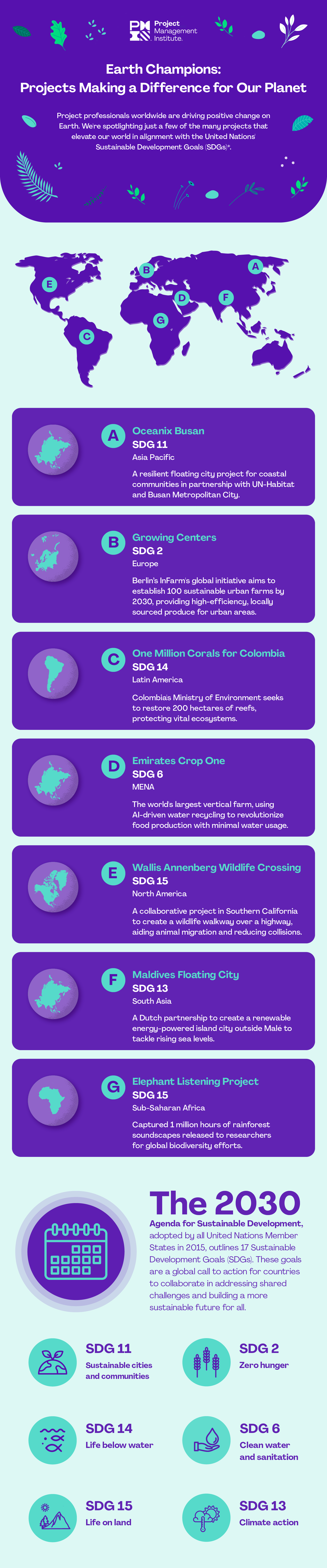
Asia Pacific: Oceanix Busan
Coastal cities are in crisis. To address flooding threats exacerbated by climate change, UN-Habitat partnered with Busan Metropolitan City and sustainable tech firm Oceanix to create a new approach: floating, flood-proof cities. This “modular maritime neighborhood” will extend the South Korean port city of Busan into the ocean and house up to 12,000 people. Equipped with solar power, greenhouses that expand and contract based on need, and extensive public spaces to foster a sense of community, this offers a sustainable future for coastal residents worldwide.
The project exemplifies the spirit of SDG 11, which aims to make cities and human settlements inclusive, safe, resilient, and sustainable. By creating floating, flood-proof cities, the project directly addresses the challenges coastal cities face due to climate change and extreme weather events.
Europe: Growing Centers
Berlin’s InFarm established themselves as forward-thinking food producers, using machine learning and Internet of Things sensors to increase crop yields at their vertical urban farms. That’s why the company announced an ambitious goal: Create 100 sustainable, climate-resistant growing centers for restaurants and grocery stores around the world by 2030. This megaproject is well underway, with facilities in London, Paris, Copenhagen, Toronto, Seattle and Tokyo. Compact operations aren't just technologically advanced; they also boast high productivity. With the data they produce covering aspects like crop health, water usage, and per-plant costs, they are exceptionally efficient. The outcome Affordable, incredibly sustainable crops cultivated close to urban restaurants and grocery stores.
InFarm's Growing Centers initiative is closely aligned with SDG 2, which focuses on achieving food security, improving nutrition, and promoting sustainable agriculture. By using innovative technology, these urban farms are increasing crop yields and reducing the environmental footprint of food production.
Latin America: One Million Corals for Colombia
Hurricanes, global warming, pollution, overfishing and coastal development all threaten native coral species. So, Colombia’s Ministry of Environment and Sustainable Development took action. One Million Corals for Colombia project seeks to restore 200 hectares of reefs in part by growing coral fragments in dedicated nurseries and transplanting them. It's the largest coral restoration project in the Americas.
The project is a prime example of efforts aligned with SDG 14, which aims to conserve and sustainably use the oceans, seas, and marine resources. By restoring coral reefs, efforts protect marine biodiversity, support local ecosystems, and contribute to the livelihoods of coastal communities.
MENA: Emirates Crop One
A US$40 million joint venture between ag-tech startup Crop One Holdings and Emirates Flight Catering, Emirates Crop One claims the title of world's largest vertical farm. It uses an AI-powered closed-loop water recycling system capable of growing two million pounds (907,185 kilograms) of fresh produce annually, with 95 percent less water than field-grown fruits and veggies. The technology-driven operating system has the potential to revolutionize food production, not only in the United Arab Emirates (where nearly 90 percent of food is imported due to limited arable land and a severe water shortage) but also globally.
Emirates Crop One's vertical farming initiative directly contributes to SDG 6, which focuses on ensuring availability and sustainable management of water and sanitation for all. By using advanced technologies, the project reduces water usage in agriculture significantly. This approach not only addresses water scarcity challenges but also promotes sustainable agricultural practices.
North America: Wallis Annenberg Wildlife Crossing
For the mountain lion community in Southern California, USA, the 100-year-old highway that cuts through their natural habitat strands animal populations on either side, disrupting their ecosystems. So, a slew of partners—including Caltrans, National Wildlife Federation, National Park Service, the Santa Monica Mountains Conservancy, the Mountains Recreation & Conservation Authority, the Resource Conservation District of the Santa Monica Mountains—stepped up. The Wallis Annenberg Wildlife Crossing will be a lion-friendly walkway that spans the massive highway, providing a path between the protected lands on either side.
The project aligns with SDG 15, which aims to protect, restore, and promote sustainable use of terrestrial ecosystems. By providing a safe passage for wildlife across highways, the project mitigates the negative impacts of infrastructure development on biodiversity.
South Asia: Maldives Floating City
Government leaders in the Maldives believe a floating city could address the urgent risk of the island country being swallowed by the effects of climate change. Launched in partnership with Dutch architecture studio Waterstudio and construction company Dutch Docklands, the massive infrastructure project could serve as a scalable blueprint for other coastal communities. Slated to be built just outside of the Maldives’ capital of Malé, the new island city will be powered by renewable energy and provide space for homes, a hospital, a school and commercial properties.
The Maldives Floating City project is intricately linked with SDG 13, which focuses on taking urgent action to combat climate change and its impacts. By creating a sustainable, renewable-powered floating city, the project addresses the existential threat of rising sea levels and climate-induced disasters. This innovative approach not only safeguards vulnerable communities but also sets a blueprint for climate-resilient infrastructure development worldwide.
Sub-Saharan Africa: Elephant Listening Project
The Elephant Listening Project eavesdropped on the rainforest of the Republic of Congo via 50 microphones hidden in trees. The mission was to listen for the call of forest elephants to understand where they are, what they're doing, and what they're trying to communicate. But the recordings also captured other species. The project released all one million hours of soundscapes for researchers all over the world to use in their own biodiversity efforts.
The project's use of data science and technology aligns with SDG 15, which aims to protect, restore, and promote sustainable use of terrestrial ecosystems. By monitoring forest ecosystems and biodiversity through soundscapes, the project contributes to conservation efforts and promotes scientific research essential for effective ecosystem management.
Start taking action.
It's our collective responsibility to protect and preserve our planet, and these diverse projects serve as beacons of hope and progress. These projects not only address pressing environmental challenges but also contribute to building a more sustainable, resilient, and inclusive world. As project leaders, let's continue to support and champion such endeavors, ensuring a brighter and greener future for generations to come.
Discover strategies for integrating ESG considerations into your projects and fostering a culture of sustainability across your organization:
ESG Goal-Setting Framework Template
Build ESG into your planning with a goal-setting template and impact measurement framework based on the U.N.’s 17 SDGs.
How Project Teams are Building Climate-Resilient Infrastructure
Building sustainable infrastructure doesn't just protect people and the planet—it boosts the bottom line. Project teams must deliver assets that can withstand the extreme effects of climate change.
Project Management in a Green World: Including Sustainability
Sustainability is more than a buzzword; it's a strategic advantage. Explore how incorporating sustainability principles into your project planning can lead to cost savings, reduced risks, and improved reputation.
Tags: Project Management | Motivation | Social Impact
Learn more about our commitment to sustainability
Explore PMI certifications, eLearning, research, and insights on sustainability.
Read More from PMI Blog


