How NASA Used Project Management to Deliver Artemis II
NASA Program Manager Shawn Quinn shares the leadership and project management lessons behind Artemis II, from coordinating more than 3,000 people and managing mission-critical risks to building a culture where teams communicate openly and solve complex challenges together.

Nine days. One spacecraft. More than 250,000 miles from Earth.
When Artemis II launched, the world watched four astronauts begin humanity's return to the moon. What most people didn't see was the years of planning and organization, thousands of people involved, and countless decisions required to make that moment possible.
What is Artemis II?
Artemis II is NASA's first crewed mission under the Artemis program, marking humanity's return to deep space exploration beyond low Earth orbit since the Apollo era. The mission sent four astronauts on a journey around the moon to test the Orion spacecraft and Space Launch System (SLS) rocket.

"When I was growing up as a young boy, I can recall the Apollo missions and watching the astronauts walk on the moon on the television in our family room,” he recalls. “I have been interested in working on the space program for as long as I can remember. I can honestly say there's only one place I wanted to work, and that was for NASA at the Kennedy Space Center to launch rockets to the moon."
That dream led to a 40-year NASA career supporting the Space Shuttle Program and, ultimately, Artemis II.
Shawn led NASA's Exploration Ground Systems Program, overseeing the teams responsible for receiving, assembling, integrating, testing, launching, and recovering the hardware that makes Artemis missions possible. Rocket components arrived by truck, rail, barge, and plane before being assembled inside the Vehicle Assembly Building. There, teams prepared every element of the mission, from launch countdown demonstrations with the astronauts to recovering the Orion spacecraft after splashdown.
Project management at moon-mission scale
Sending astronauts around the moon requires thousands of people working as one team. As a program manager, Shawn says his role extends far beyond technical oversight.
He's responsible for technical performance, schedule, budget, and risk management across a program supported by more than 3,000 people across various roles.
But for Shawn, success depends on something even bigger: people.
His job is ensuring teams—from Orion to Space Launch System to Ground Systems—are working toward the same mission.
What does a NASA project manager do?
As Program Manager for NASA's Exploration Ground Systems, Shawn coordinated more than 3,000 people responsible for integrating, testing, launching, and recovering Artemis II.
How is project management used at NASA?
At NASA, project management connects engineering, schedule, risk management, communication, and leadership across thousands of contributors working toward one mission.
How NASA manages risk on complex projects
Even after years of preparation, Artemis II faced challenges before launch. The first came after Artemis I.
The launch’s 8.5 million pounds of thrust damaged portions of the mobile launcher more extensively than expected. Teams replaced thousands of feet of pneumatic tubing, reinforced elevators inside the 400-foot launcher, strengthened critical systems for launch conditions, and applied lessons learned from previous missions.
The work was massive, but the team still held schedule for an entire year. Then another challenge emerged.
Following a successful wet dress rehearsal—a full launch countdown and fueling test conducted without liftoff—engineers discovered a blockage inside a helium quick disconnect. Rather than searching for someone to blame, the team immediately shifted into problem-solving mode.
“We weren’t trying to defend,” explains Shawn. “We said, ‘This is the issue, this is what we’ve got to do.’”
Engineering teams from NASA programs, contractors, and United Launch Alliance came together to reproduce the issue in a test facility.
After identifying the problem, the team redesigned the component, validated the fix through rigorous testing, rebuilt the quick disconnect over a single weekend, and returned the vehicle to schedule.
For Shawn, this is what project management looks like under pressure.
“As a program manager, you must make sure that your technical team knows that their highest figure of merit is doing things right and safely.”

As a program manager, you must make sure that your technical team knows that their highest figure of merit is doing things right and safely.
How NASA determines a mission is ready to launch
There were two moments Shawn knew Artemis II would succeed.
The first came when the vehicle rolled out exactly when planned after holding schedule for an entire year. The second came during the team's flawless second wet dress rehearsal.
They fully fueled the vehicle, counted down to T-minus 31 seconds (twice) and validated hundreds of launch constraints.
Eventually, launch day arrived. The countdown encountered only two issues: one involving the range and another involving Orion’s launch abort system batteries, which engineers quickly resolved.
“We launched that day,” he recalls. “It was beautiful.”
Why psychological safety matters in project management
Shawn's leadership philosophy has been shaped by both success and tragedy. Having lived through the Challenger and Columbia space shuttle disasters, which led NASA to fundamentally rethink safety and risk management, safety remains non-negotiable. The lesson he hopes other leaders take away isn't specific to aerospace.
PMI Infinity™ Insight: Psychological Safety
PMI views psychological safety as essential for strong project teams. It means team members can speak up, raise risks, ask questions, and admit mistakes without fear.
PMI’s guidance implies that project leaders should foster:
- Trust and mutual respect across the team.
- Inclusion and openness, so different perspectives are heard.
- Constructive handling of failure, treating mistakes as learning inputs rather than blame triggers.
- Ethical, transparent communication, especially when surfacing concerns or uncertainty.
Shawn believes the mission succeeded because of more than technical excellence; it succeeded because of the culture behind it.
"The most important thing when it comes to making multi-program efforts like Artemis II successful is creating the right environment and culture where we all have each other's back," he explains.
For Shawn, psychological safety isn't a leadership buzzword. It's an operational requirement.
"You've got to have an environment where it's open and safe to communicate issues in a timely and accurate way,” Shawn explains.
You've got to have an environment where it's open and safe to communicate issues in a timely and accurate way.
For him, that responsibility begins with leadership.
"The program managers have to set the expectation for timely communication,” he says. “And the only way you get timely communication is when you have a safe environment for people to speak up."
Looking back across four decades at NASA, Shawn says the greatest leadership lesson he's learned is simple: "You've got to create a safe environment where people can speak up early and often."
But he recognizes saying it isn't enough. "When they actually do bring a challenge to you, you've got to thank them for bringing it to you,” he says.
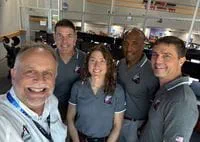
The hidden work behind successful projects
While millions watched launch day, Shawn says the real story unfolded long before the countdown.
"Every single day leading up to launch, the team was demonstrating grit and determination," he explains.
That dedication often came at a personal cost. Engineers postponed vacations, worked around the clock, and missed family milestones to solve problems that the public would never know existed.
He remembers one engineer canceling Christmas travel after corrosion was discovered in critical cooling system lines.
"I'll be forever thankful for that,” he says.
How project leaders build stakeholder trust
Managing a mission this visible also means communicating with engineers, NASA leadership, Congress, the media, and the public.
For Shawn, transparency builds trust. When problems arise, leaders should communicate openly, even when they don't yet have all the answers. By explaining what the team knows, what it doesn't know, and what comes next, stakeholders become partners in solving challenges rather than observers waiting for updates.
Mission first
Whether leading thousands of people toward the moon or managing projects in any industry, Shawn believes the principle remains the same: "When you know you have each other's back, then we can handle any challenge that comes our way,” he says.
For Shawn, project management isn't only about delivering extraordinary missions. It's about bringing people together around a shared purpose and creating an environment where they can solve hard problems safely, openly, and together.
"What we're doing is incredibly important for our nation, our species, and our planet,” he says. “So, remember why we're here."
Tags: Leadership | Project Management
Ready to lead complex projects with confidence?
PMI certifications are designed to help you manage risk, lead teams, and deliver successful projects, no matter the industry.
About the Author
Autumn Granza, CAPM
Integrated Marketer
Autumn Granza is an integrated marketer and storyteller passionate about uncovering the human stories behind projects and their impact on the world around us. At PMI, she develops marketing campaigns and multichannel content strategies that engage audiences, inspire action, and connect people with the power of project management. Her work spans campaign strategy, storytelling, and audience engagement, helping people discover project management in places they might never expect.
Read More from PMI Blog



Related Insights
The PMP Exam and Modern Project Leadership
Preparing for the PMP exam? Understand the leadership, business, and decision-making skills the exam now emphasizes.
You May Also Like

Certification
Project Management Professional (PMP)®
3+ years of experience leading projects

Certification
PMI Risk Management Professional (PMI-RMP)®
3-5 years of experience
Demonstrate your skills to spot threats early, master risk management, and lead projects to success.
PMBOK® Guide
PMI Standard
Backed by the authority of PMI and shaped by professionals worldwide, the PMBOK® Guide defines the global standard for project management.