How to Apply for the PMP: What Counts as Project Management Experience
Preparing your PMP application can raise questions about whether your project management experience qualifies. Learn what counts as project management experience, how to describe your work clearly, and what to know before you apply.

Preparing your Project Management Professional (PMP)® application can feel like a project in itself. You need to understand the PMP eligibility requirements, gather your information and describe your project management experience clearly enough for PMI to verify that you have led and directed project work.
The good news: You do not necessarily need the title “project manager” to have qualifying experience.
The more important question is whether your professional work shows that you have led projects, guided teams or stakeholders, managed delivery and helped create value. If you have been doing that work, the PMP application is where you translate it clearly, accurately and honestly.
Start with PMP eligibility
Before you start your PMP application, confirm that you meet PMI’s eligibility requirements. PMP eligibility is based on a combination of education, professional project management experience and project management training. The exact requirements vary by educational background, so candidates should review the official PMP certification page before applying.
This article focuses on one part of the application that candidates often find confusing: how to understand what counts as project management experience, what does not count and how to describe your work clearly.
What counts as project management experience?
For the PMP application, PMI is looking for professional experience leading and directing projects. The experience does not necessarily have to be paid work, but it does need to take place in a professional setting.
A project is temporary work undertaken in a unique context to create value. It has a beginning and an end, even if it is part of a larger organizational effort. The work may involve a distinct goal, set of stakeholders, delivery approach, business need or operating environment.
That means your qualifying experience may come from many kinds of work, including:
- Leading a system implementation
- Managing a product, service or process launch
- Coordinating a cross-functional improvement initiative
- Guiding a regulatory, compliance or governance project
- Managing a customer-facing delivery effort
- Leading workstreams within a larger program
- Coordinating scope, schedule, risk, resources, communications or stakeholder engagement for a defined project
The job title matters less than the work itself. A candidate with the title “project coordinator,” “program analyst,” “operations lead,” “implementation manager” or “team lead” may have qualifying experience if they can show that they were leading and directing project work.
The reverse is also true. A project manager title does not automatically make all work count. The experience still needs to be tied to projects, not only routine operations.
What does not count as PMP project experience?
Some work is valuable, but it does not qualify as PMP project management experience. For instance, school projects, academic research for a degree-granting program, planning personal events and home improvement projects do not qualify. Project entries also should not include routine, operational or administrative tasks.
Answering routine customer requests every week is operational work. Leading a defined initiative to redesign the customer intake process, coordinate stakeholders, manage timelines and measure the outcome may be project work.
What matters is whether the work had a defined objective, a unique context and value to deliver.
How to describe your project experience on the PMP application
The experience verification section of the PMP application is where you record your professional work experience leading and directing projects.
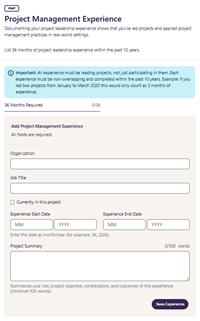
For each project, be ready to explain:
- What the project aimed to accomplish
- When the project started and ended
- How you led or directed the work
- Who you worked with or influenced
- Which project activities you led or directed
- What value, output or outcome the project delivered
Be specific, but do not inflate your role. The strongest descriptions are clear and grounded. Instead of writing only:
“I supported a software rollout.”
A stronger description would explain the project context and your leadership role:
“I led the implementation planning for a software rollout across three business units, coordinating stakeholder requirements, schedule milestones, user communications, risk tracking and transition planning.”
That type of description helps show the project management work behind the assignment.
Good project experience descriptions often include work such as:
- Defining scope or success criteria
- Building or managing schedules
- Coordinating resources
- Managing risks, issues or changes
- Engaging stakeholders
- Communicating project status
- Supporting governance or decision-making
- Tracking deliverables or outcomes
- Closing or transitioning the work
Focus on making your project role, contributions and outcomes clear.
Watch for overlapping project months
PMP experience is measured in months, not by the number of projects you completed. It also needs to fall within PMI’s 10-year eligibility window, so check your project timeline before you apply.
That matters when projects overlap. If you led two projects during the same three-month period, you cannot count those same three months twice. You can list both projects, but the overlapping time only counts once toward your total experience requirement.
For example, if Project I ran from 1 January – 31 March, it would count as three months toward the eligibility requirement. If Project II ran from 1 February – 31 May, only April and May would count towards the eligibility requirement, because February and March already counted for Project I. Together, the two projects would equal five months of project management experience, covering 1 January–31 May.

This is one reason it helps to map your projects before you apply. Create a simple list of project names, dates and your role. Then look for overlapping time periods so you understand how many months of experience you can accurately claim.
What to do if you are not sure you qualify
If you are close but unsure, do not dismiss your experience too quickly. Start by reviewing your work history through a project lens.
Ask yourself:
- Which work had a defined beginning and end?
- Which efforts had a specific business goal or outcome?
- Where did I lead people, decisions, stakeholders or delivery?
- Which work was routine operations, and which work was temporary project work?
- Can I describe my role clearly and honestly?
You may find that you have more project experience than you first thought. You may also find that some work should be left out of the application because it was operational, administrative or personal.
If you do not yet meet the PMP eligibility requirements, the Certified Associate in Project Management (CAPM)® certification may be a better starting point. Many professionals begin with the CAPM and pursue the PMP later as they gain more project experience. It can help you build project management knowledge while you continue gaining professional project experience.
Apply with clarity and confidence
The PMP application is where you show that your experience aligns with the expectations of a globally recognized project management certification.
You do not need a perfect job title. You do need real professional experience leading and directing projects. You also need to describe that experience in a way that is clear, accurate and tied to project outcomes.
Start with the official PMP eligibility requirements. Map your project experience. Separate project work from routine operations. Then tell the story of your project leadership by describing what you led, how you contributed and what value the work created.
Tags: PMP | Certification | Exam | Career Development
Ready to get your PMP?
Review the official PMP eligibility requirements, confirm your project experience and start your application with confidence.
About the Author
Deborah Walker, CPMAI
Content Marketing Lead
Deborah Walker leads strategy and hands-on execution for PMI’s owned content platforms, including the PMI Blog, Projectified® podcast, LinkedIn newsletter, and more. She collaborates with subject matter experts and senior leaders to translate complex topics into clear, actionable guidance for project professionals.
Read More from PMI Blog


Related Insights
PMP Exam Prep: Resources, Study Strategies, and Exam Advice
Learn how to pass the PMP exam with expert study strategies, motivation tips, PMI resources, and real advice from PMP-certified professionals.
You May Also Like

Certification
Project Management Professional (PMP)®
3+ years of experience leading projects