Project Sponsor Responsibilities: Governing Sustainability and Long-Term Value
Project sponsor responsibilities extend beyond approving a project. Learn how responsible sponsorship brings sustainability, governance and long-term value into the decisions that determine project success.

The global project community has spent decades building capability in planning, execution, and control. Standards matured. Education and training improved. Project managers are better prepared today than they have ever been. And projects still fail too often on delivering the intended outcome.
One of the causes sits above the project. The people who authorize, shape, and sustain projects have largely been left to figure out the role on their own. Sponsors are named based on position or availability. Expectations remain implicit. Guidance is limited. Accountability gets assigned without the preparation, clarity, or support the role requires. The costs of that assumption show up as deferred decisions, eroded mandates, ungoverned trade-offs, and value that never fully materializes. Those costs get absorbed into the normal variation of project outcomes, and they rarely get traced back to the sponsorship gap that produced them.
The PMI® GPM® Guide to Responsible Project Sponsorship addresses that gap. Written for executives and senior leaders who authorize and govern projects, it defines what responsible sponsorship requires and provides practical tools for the decisions sponsors face throughout the project life cycle. Here is some of what it covers.
A project can be well managed and still fail
Delivery performance measures execution against a plan. A project can meet every target for time, cost, and scope and still fail to produce value, because the outcomes it was meant to create do not hold, the assumptions it rested on were never tested, or the decisions shaping it were never properly governed. Sponsors are accountable for whether the project remains justified, whether its outcomes persist, and whether its impacts remain acceptable over time. A status report can show whether the work is on track. It cannot tell you whether the project is still worth doing. That is a governance decision.
Governance rarely fails through a single breakdown. It drifts. An issue gets handled inside the team because raising it feels premature. A trade-off gets absorbed into delivery to avoid alarm. Each deviation looks reasonable on its own. Together, they move decision-making out of the governance structure, and the reports will not say so. Sponsors who watch for these patterns catch the loss of control before it becomes a crisis.
Four decisions every project sponsor owns
Across every industry and delivery method, four decisions sit at the center of project sponsor responsibilities: whether to authorize a project, whether to continue it, whether to change its mandate, and whether to stop it. Most organizations apply real rigor to the first one. Projects get approved with scrutiny. They are rarely continued, changed, or stopped with the same discipline, and that imbalance is where governance weakens. These four decisions also form a cycle. Sponsors revisit them throughout the project life cycle, at formal gates and whenever the basis for justification shifts. Authorization stays open from start to finish.

Continuation is the least examined decision in most projects. Once work begins, momentum takes over. Progress creates expectation. Investment creates commitment. Under those conditions, continuation becomes the default. Responsible sponsors treat it as a decision, made on the same basis as the original authorization: whether the project still justifies its investment, risk, and impact. Practical checks at the point of decision can help sponsors resist, when momentum is pulling hardest toward proceeding.
Seven accountabilities of the project sponsor
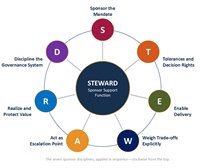
The sponsor role is organized around a construct called STEWARD: sponsoring the mandate, setting tolerances and decision rights, enabling delivery, weighing trade-offs explicitly, acting as the escalation point, realizing and protecting value, and disciplining the governance system. These accountabilities operate together. Weakness in one usually signals a breakdown in how the whole system is being governed. Project managers, steering committees and PMOs can support this work, but they cannot take on the sponsor’s accountability.
Sustainability belongs in project sponsor decisions
Responsible project sponsorship means governing a project for more than delivery. Projects are temporary, but their consequences can last for decades. Infrastructure commissioned today shapes operating costs, community impact, and environmental exposure for a generation. Supply chain choices made under schedule pressure create regulatory and reputational exposure that surfaces long after the team has moved on. The decisions that define a project's long-term consequences are almost always made early, under pressure, when those consequences are hardest to see.
This is where sustainability enters the sponsor's work. When sponsors remain accountable for whether a project is still worth doing, sustainability stops being a separate subject. It becomes part of every significant decision sponsors make: whether outcomes will remain viable over time, whether risks extend beyond the delivery period, and whether the project remains legitimate to the people who live with what it produces. Those considerations can be integrated into the decisions sponsors already own, using the governance mechanisms already in place.
Four questions project sponsors should ask
Sponsors do not need to be sustainability analysts. They do need to recognize when a decision changes the project’s long-term value, risk or legitimacy. At key decision points, that means asking questions such as:
- Will the outcomes still be considered valuable three to five years after handover?
- Does this trade-off create exposure that will surface after the project closes?
- Does this risk affect people or systems whose response will not be visible during delivery?
- Have conditions changed enough to alter the project’s continued justification?
Project managers have earned decades of investment in their preparation. Sponsors deserve the same clarity, tools and support. The decisions they make determine whether projects simply finish or deliver value that lasts.
Tags: Sustainability | Project Sponsorship | Project Sponsors | Project Governance | Project Success | Leadership
Strengthen project sponsorship
Explore The PMI® GPM® Guide to Responsible Project Sponsorship for practical guidance on governing projects for lasting value.
Quick Answers to Common Questions About Responsible Project Sponsorship
What is responsible project sponsorship?
Responsible project sponsorship is the ongoing governance of whether a project remains worth doing — not simply its initial approval. It keeps the project’s mandate, value, risks and long-term impacts visible as conditions change.
What are the main project sponsor responsibilities?
Project sponsors authorize the work, define and protect the mandate, establish decision rights and tolerances, govern major trade-offs, resolve escalated issues and remain accountable for continued justification and value realization. They create the conditions for effective delivery without taking over the project manager’s day-to-day role.
What is the difference between a project sponsor and a project manager?
The project manager plans, coordinates and manages delivery within agreed boundaries. The project sponsor establishes and governs those boundaries, resolves decisions beyond the project manager’s authority and remains accountable for whether the project continues to justify its investment.
How does sustainability fit into project sponsor responsibilities?
Sustainability extends the sponsor’s view of value, risk and consequence beyond the delivery period. It brings environmental, social, operational, regulatory and reputational impacts into the decisions sponsors already own, including whether to authorize, continue, change or stop a project.
When should a project sponsor reconsider whether a project should continue?
Sponsors should revisit continuation when important assumptions weaken, decision tolerances are exceeded, risks or external conditions change, or accumulated trade-offs alter the project’s mandate or value proposition. Progress, prior investment and organizational momentum should not make continuation automatic.
What PMI resource can help project sponsors govern for long-term value?
The PMI® GPM® Guide to Responsible Project Sponsorship provides practical guidance on mandate, governance, gatekeeping, sustainability, PMO support and sponsor decision-making. It also introduces STEWARD, seven connected accountabilities that clarify what sponsors own and what cannot be delegated.
About the Author
Joel Carboni, Ph.D., CSPP
Founder and CEO, GPM Global
Dr. Joel Carboni is the founder and president of GPM and the architect of the standards, methods, and credentials behind Sustainable Project Management®, delivered through the PMI-GPM joint venture. He created the P5 Standard, the Sustainability Competence Standard, the Sustainable Project Management® Practice Guide, the Project Sustainability Reporting Guide and the Guide to Responsible Project Sponsorship. For over 30 years, his work has moved the profession in a different direction. A Forbes Business Council member and Global Reporting Initiative (GRI) contributor, he was shortlisted for the inaugural regenerative business award by Thinkers50 in 2025 for his book 'Becoming Regenerative'.
Read More from PMI Blog



Related Insights
Sustainable Project Management: From Planning to Delivery
Project leaders share how to embed sustainability in every phase, gain executive buy-in, and create lasting environmental and social impact.
You May Also Like

Certification
Certified Sustainable Project Professional (CSPP)™
Lead resilient, sustainable projects that reduce risk, adapt to disruption and deliver measurable business value.
The PMI® GPM® P5™ Standard for Sustainability
The leading standard for sustainability, aligned with the PMBOK® Guide and global guidelines to drive measurable outcomes.
PMI® GPM® Practice Guide for Sustainability
PMI Practice Guide
Integrate sustainability into project delivery and governance to deliver measurable value for people, planet and prosperity.